
Structures and procedures
School transportation
Information for parents
School transportation is an important service within the public education system. Every day, it allows hundreds of thousands of students to travel safely to school. In Quebec, more than 500,000 students are transported daily, in a system that involves thousands of routes, vehicles, and contributors.
Its operation is based on precise rules, governed by law, regulations, and the local policies of the school board (SB). For parents, a clear understanding of these rules helps avoid misunderstandings and allows them to act in an informed manner when situations arise.
The right to transportation and eligibility rules
School transportation is not an automatic right for all students. When a school board organizes transportation for school arrival and dismissal, it is free for eligible students, but these criteria are defined locally.
In most cases, students must attend their local school and live within a minimum distance of it. These thresholds vary depending on the level (preschool, elementary, and secondary) and the school board, but they are based on a simple principle: distinguishing what is considered a safe journey on foot.
A student enrolled in a school outside their catchment area following a school choice may not have access to transportation or may have to pay fees if they want to use it (under certain conditions).
Transportation policies are based on common criteria: distance, route safety, route organization, and available capacity. Transportation is organized collectively, meaning that a transit authority is not obligated to modify a route or add a stop to meet an individual request.
The Quebec regulatory framework also stipulates that school transportation must be organized in a safe and efficient manner, respecting the standards applicable to vehicles, drivers and operations.
Your school board’s transportation policy
The transportation policy is the central document. It determines distances, eligibility criteria, rules for schools outside the service area, conditions related to shared custody, and applicable fees.
Certain elements deserve special attention, including the minimum distance to be entitled to transport, the distance to the stop, the criteria used to judge whether a trip is safe, and the situations in which transport may be refused or charged.
A good knowledge of this policy allows for a better comprehension of the CSS’s decisions and helps avoid several misunderstandings.
School boards publish their policies on their websites. Often in a section titled “policies” or “school transportation”.
The SBs have online tools to determine whether our child is entitled to school transport and which route he should use, including the Mozaïk Parent portal and the Clic-École application.
Distances and decisions of the SB
The distance between a student’s residence and the school is a key factor in determining eligibility. A difference of just a few meters can be enough to make a student ineligible or not. Therefore, only the distance officially calculated by the school board is recognized. To ensure fairness, all distances are established using the same system, guaranteeing consistent application of the rules for all students.
These calculations may differ from those obtained with a tool accessible to everyone, such as Google Maps, which suggests the shortest route, but not necessarily the one chosen by the SB. Therefore, a simple check with this type of tool is not, on its own, sufficient to overturn a decision.
School boards use geomatics tools based on recognized and safe routes. These calculations take into account concrete factors, such as intersections, the presence of sidewalks, areas deemed dangerous and routes that are actually usable.
Asking questions or requesting explanations
Certain situations should prompt parents to ask questions and request clear explanations.
This is particularly the case when the distance chosen seems clearly inconsistent with the reality on the ground, when a walking route appears unsafe, when a stop is deemed too far away or when a service is refused in a particular context.
In these situations, it is legitimate to ask the school transport organization service of your SB on what criteria the decision is based, how it was made and to which specific policy rule it relates.
Asking the right questions, with concrete evidence, often leads to a better understanding of the situation and, sometimes, to its evolution.
Costs and specific contexts
Daily transportation is free for eligible students. However, certain situations may result in fees.
Lunchtime transportation is often subject to a fee, as it is not included in the basic service. Transportation to a second address, particularly in the context of shared custody, is not an automatic right. It depends on network capacity and the rules of the school board. Fees may also be charged for available spaces or for certain specific programs.
School transportation is generally not provided on pedagogical days. Parents must then arrange transportation, often in conjunction with childcare services.
In several regions, the school board may also use public transit networks to serve certain students, particularly at the secondary level. In these cases, the student receives a transit pass (card or season ticket) and must comply with the rules of the public transit provider.
Ghost seats, very real costs
It frequently happens that students registered for transportation are systematically driven to school and back by their parents. Unfortunately, these unused seats represent significant costs for school boards, which organize and pay for routes for students who do not use them.
It is important for parents to be aware of the significant budgetary impact of these unused spaces, sometimes kept simply “just in case.” A parent can choose to withdraw their child from transportation to promote more efficient use of resources, without automatically losing their right to return , according to the SB’s rules.
In this context, some school service centres have changed their operations by asking parents to explicitly confirm their use of transportation (voluntary registration), rather than automatically registering all eligible students (default registration). This approach allows for a more precise adjustment of routes to the actual use of the school transportation service.
Vehicles and safety rules
School transportation is not limited to yellow buses; it adapts to specific cases and realities of different environments. Depending on the needs, school boards also use minibuses, sedans, or vans, particularly for certain students or in specific situations.
Regardless of the vehicle, minimum safety standards apply. Drivers must be qualified, and vehicles must be compliant and well-maintained. On school buses, signaling devices (red lights, stop arms) protect students when boarding and alighting, and motorists are required to stop. Vigilance remains essential, and students must be made aware that some danger persists.
Safety also depends on the student’s behavior, who must adopt safe practices at all times, both when at their stop and in the vehicle. Among other things, they must remain seated, respect the driver, avoid pushing and shoving, and keep the aisles clear. Certain items are prohibited, particularly bulky equipment.
Failure to comply with the rules may result in disciplinary action, up to and including suspension of transport. In this case, parents are responsible for their child’s transportation.
Seat belts in school buses
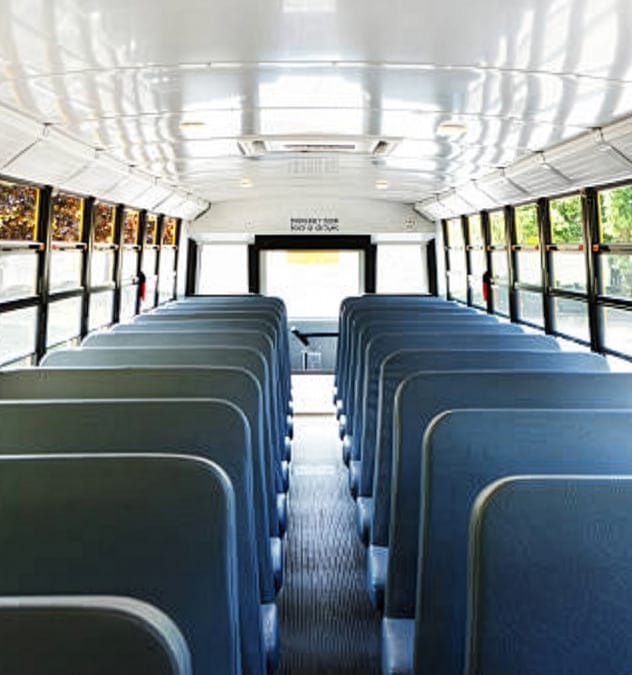
Unlike cars, school buses do not rely on seat belts as their primary means of protection. They are designed according to a principle called compartmentalization, based on high, closely spaced, and padded seats that absorb energy in the event of an impact.
According to Transport Canada and the Canadian Safety Council, this concept offers a very high level of protection, although authorities acknowledge that seat belts can provide additional protection in certain types of impacts, particularly side impacts or rollovers. This is why some newer buses are equipped with them.
Installing seat belts on school buses requires that all students be properly fastened, which necessitates supervision, especially for younger children. In emergency situations, such as a rapid evacuation, the seat belts could slow down the students’ exit.
A shared responsibility
School transport relies on a balance between accessibility, safety, and organization. It is a collective, supervised, and structured service that requires everyone’s cooperation.
For parents, a clear understanding of the rules, responsibilities and limits of the service allows them to better support their child and contribute to a safe and functional environment for all students.
School boards plan routes and stops, while the school transmits essential information to parents: schedules, assigned stop, instructions. Parents should refer to it and ensure that their child is ready, on time, and informed of the expected behavior on school transport.
For preschool children or those who are not independent, the presence of an adult at the stop is required, both on the way there and on the way back.
Tools like Clic-École allow parents to access transportation information. In some school service centres, cards with an electronic validation system are also used to track students. Students must then have their card with them at all times and present it when boarding and alighting from the bus.